 Low Back Pain Coach
Week one on a 45-degree back-extension bench
Emergency signs come first: new numbness around the groin, bladder or bowel changes, weakness in both legs, and the rest of the list. If none of them apply and your clinician has cleared you to exercise, this page covers your first week on a 45-degree back-extension bench: where the pad goes, where to stop, and what to write down tomorrow.
The bench is required. The program is written for a 45-degree bench, not a vertical 90-degree Roman chair. At a gym or at home both work, and the buying guide covers what to look for.
Session one on the bench
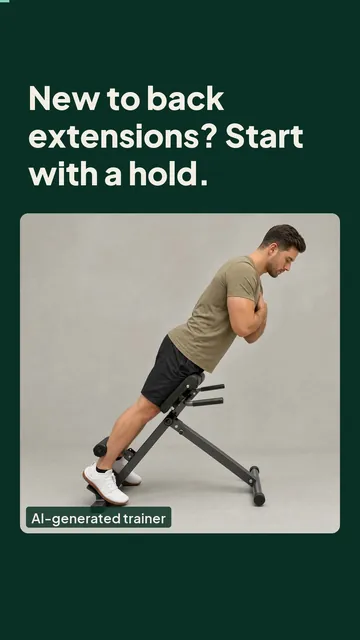
- Set the pad so its top edge sits just below the crease where your thighs meet your pelvis. Your hips rest on the pad and your feet are anchored under the roller.
- Cross your arms and rise to the top. Stop where your shoulders, hips and ankles form one straight line. Do not arch past it and do not bounce.
- Write down how your back feels tomorrow, on the same 1 to 10 scale as your usual pain on an ordinary day. That number sets the next session.
The first session is 3 holds of 15 seconds with 60 seconds of rest between them. If you start in the app on the bench, its setup questions may set the holds at 10, 13, 15, 18 or 20 seconds. It may feel too easy. Start there anyway, because a dose your back barely notices gives you a clean reading the next morning. The isometric hold guide has the details, and why back extensions hurt covers pad height and range if something feels off.
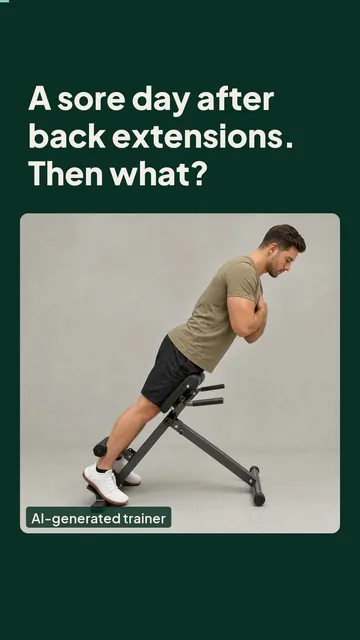
What tomorrow's log sets
| Next morning, compared with your usual | The next session |
|---|---|
| Worse | About 30 percent shorter holds, never below 5 seconds |
| The same | The same session again, unless the previous training day's next-morning check-in was also at or below baseline, and neither was higher than the pain you logged before that session. Then 5 more seconds on the shortest hold |
| Better | 5 more seconds on the shortest hold (the first, if several match), when that check-in is not higher than the pain you logged before that session. Otherwise the session repeats |
| Pain in your legs | No session. Stop the extension work and do not add load |
Two or three sessions a week with a day between is the plan, about 10 minutes each. The log is a pacing rule. It cannot tell you what is wrong with your back, and one noisy morning is not a verdict. The first-week guide walks through the rest of the week, and the four stages show where it goes next.
A printable card
Week one on a 45° back-extension bench is a one-page PDF with the six steps, the log rule and the emergency signs. There is no email form. Print it and keep it by the bench.
What the app costs
Low Back Pain Coach is the guided version of this page. A voice counts the holds and the rest, and your next-morning log sets the next session. The download and the first guided session are free, and without a plan the pain log, lessons and flare-up help stay free. After that it is $59.99 a year or $9.99 a month, with a 7-day free trial for eligible new subscribers. It needs the 45-degree bench. What the app does and costs.


What the guidelines say
The World Health Organization's December 2023 guideline on chronic primary low back pain includes exercise in care (WHO). That is about exercise in general, not this app. A 2021 Cochrane review of 249 trials found exercise probably reduces chronic low back pain compared with no treatment, usual care or placebo (Hayden and colleagues). This exact progression has not been tested in a trial.
Why this page exists
The person who built the app had low back pain for about ten years, and he followed a slow back-extension progression on a 45° bench for about eight months. His pain went down a lot. Read the story.
Everyone's back is different, so results vary and aren't guaranteed. A Cochrane review of 249 trials found that exercise programs for chronic low back pain reduced pain on average compared with no treatment, usual care or placebo, by about 15 points on a 100-point scale at the first follow-up (closest to 3 months), and improved day-to-day function by a smaller amount. This exact progression has not been tested in a trial. The app is not medical treatment; talk to your doctor before starting a new exercise program, and stop and get help if you have any of the warning signs listed in the app.
Stop signs
Go to emergency care now for new numbness, tingling or a change in feeling in the saddle area (around the groin, inner thighs, genitals or anus), new bladder or bowel changes, new changes in sexual function, new pain, tingling, numbness or weakness in both legs, leg or foot weakness that is getting worse, or back pain that started after a recent serious accident. See a clinician today for other new weakness or numbness in one leg or foot, fever or chills with back pain, new pain after a recent smaller fall or knock, unexplained weight loss or a history of cancer, pain that is rapidly getting worse, or pain that is constant at rest and worse at night, not tied to movement. Use urgent care if you cannot get an appointment today. The red-flag page has the full list.
Common questions
Where does the pad go on a 45-degree back-extension bench?
Its top edge sits just below the crease where your thighs meet your pelvis, so your hips rest on the pad and your back is free to move. Set too high, the pad pushes into your stomach.
How far up should I go?
Stop where your shoulders, hips and ankles form a straight line. Going past it arches your lower back, and some backs do not like that.
Do I need a bench to use the app?
Yes. The program needs a 45-degree back-extension bench. Without one, the app starts you on a short floor session until you have a bench, and that floor session is not an equipment-free version of the program.
Sources
The app
I built Low Back Pain Coach to run this program: it reads your pain logs, writes the next session, and a voice counts the holds, reps and rest. A notebook can run the same rules if you would rather keep the decisions on paper.
The program on one page
The printable program card has the four stages, the next-morning rule, and the stop signs on one sheet.
If you want an email when the program or the app changes, leave your address. A few emails a year at most, and a reply to any of them takes you off the list.